Who We are
We offers TIC services to enhance fire, life, and electrical safety globally, ensuring compliance and reducing risks.
NFPA Global Solutions Guidance on NFPA 25 Requirements for Fire Sprinkler Systems Testing and Replacement
NFPA research unequivocally confirms that properly functioning sprinklers can significantly reduce the extent of property damage and increase the chance of building occupants escaping a fire. Whether you are an authority having jurisdiction (AHJ), an inspection, testing, and maintenance (ITM) contractor, facility manager, or building owner, it is critical you understand NFPA 25, Standard for the Inspection, Testing, and Maintenance of Water-Based Fire Protection Systems requirements, and the latest guidance for sprinkler replacement and testing intervals.
To simplify the complexities, the following covers rules for field sprinkler sampling, when and why sprinklers need to be replaced or tested, at what intervals, and additional considerations and recommendations from NFPA Global Solutions. Use our handy workflow exercise at the end to confirm when your system is due for testing or replacement.
What is NFPA 25, and What Does it Say About Testing and Replacing Fire Sprinklers?
NFPA 25 is the benchmark resource for water-based fire protection systems inspection, testing, and maintenance. The standard provides expert-developed content to help ensure automatic extinguishing systems (AES) are ready to respond in an emergency.
According to NFPA 25:
Why are Sprinklers Replaced and Tested on Different Intervals?
When to test or replace sprinklers depends on a variety of considerations such as the response type, age, and environment of the equipment. For instance, degradation can be greatly accelerated in sprinklers used in a harsh environment, making replacement/testing due much sooner. Over the years and the last several editions of NFPA 25, many replacement and initial fire sprinkler testing intervals have been extended due to factors such as:
How Do I Know When Fire Sprinklers Need to be Tested or Replaced?
While fire sprinkler testing and replacement intervals can vary widely and depend on a range of circumstances, the 2023 edition of NFPA 25, section 5.3.1, provides definitive guidance. Reference the following requirements for field sprinkler testing intervals years after system installation:
What Are the Testing Intervals of Tested Sprinklers That Remain in Service?
Should the sprinklers in the sample area be initially tested instead of replaced, and if the testing finds the sprinklers to be still acceptable (i.e., those sprinklers represented by the sample set tested remain in service), testing would then be needed periodically thereafter.
The following are the rules for subsequent fire sprinkler testing intervals according to NFPA 25:
Should Fire Sprinklers Featuring O-Ring Water Seals Be Replaced?
NFPA Global Solutions recommends identifying any sprinklers that may feature an O-ring water seal design. While not part of NFPA 25 requirements, this design has a notoriously high failure rate (>50%) and was the subject of several recalls. In other words, the chances of one or more sprinklers in a sample set of four or more failing is high. Remember that NFPA 25 requires the replacement of all sprinklers represented by that sample set to be replaced if even just one fails. As a result, outright replacement of O-ring designs is recommended.
Is My Fire Sprinkler System Due for Testing or Replacement?
Now that you’ve read the latest information and guidance and understand how and when to test, use the workflow below to see if your system needs replacement or testing.
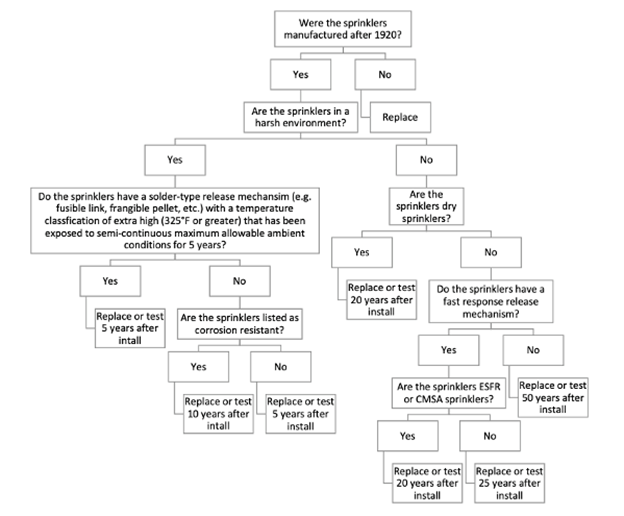
References: Mode Specific Application (CMSA) Sprinkler - A type of spray sprinkler that is capable of producing characteristic large water droplets and that is listed for its capability to provide fire control of specific high-challenge fire hazards. Corrosion-Resistant Sprinkler - A Sprinkler fabricated with corrosion-resistant material, or with special coatings or platings, to be used in an atmosphere that would normally corrode sprinklers. Dry Sprinkler - A sprinkler secured in an extension nipple that has a seal at the inlet end to prevent water from entering the nipple until the sprinkler operates. Early Suppression Fast-Response (ESFR) Sprinkler - A type of fast-response sprinkler that has a thermal element with an RTI of 50 (meter-seconds)1/2 or less and is listed for its capability to provide fire suppression of specific high-challenge fire hazards. Examples of Harsh Environments: Paper mills, packing houses, tanneries, alkali plants, organic fertilizer plants, foundries, forge shops, fumigation areas, pickle and vinegar works, stables, storage battery rooms, electroplating rooms, galvanizing rooms, steam rooms of all descriptions including moist vapor dry kilns, salt storage rooms, locomotive sheds or houses, driveways, areas exposed to outside weather, areas around bleaching equipment in flour mills, and portions of any area where corrosive vapors prevail.
Final Thoughts on Replacing and Testing Fire Sprinklers
Having a clearer understanding of the requirements and intervals for initial and subsequent replacement and testing of sprinklers can help mitigate risks and keep your people and facility safer. Be sure to reference the information in this post and NFPA 25 in your work, and feel free to reach out to NFPA Global Solutions for additional support. We offer advisory services, digital products, and compliance solutions, including fast and unbiased testing of fire sprinklers and other fire suppression equipment and systems.


.jpg)